Alerted by a very conscientous friend that this was on BBC4 earlier this week, I had long been anticipating this documentary ever since I had spied the trailer last year. I was expecting it to be in cinemas at some point but when I stopped hearing about it altogether I assumed that it had had minimal screening like 2011’s Black Power Mixtape and I had missed the boat so I was very excited to hunker down at such a late hour to watch this.
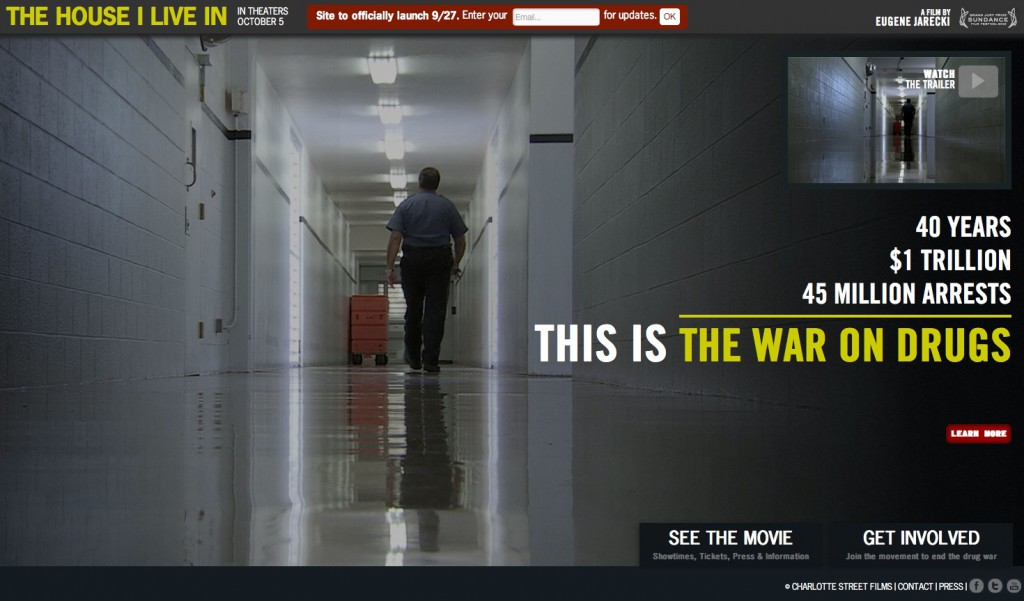
The House I Live In is an expansive documentary about the 40 year-old so-called War On Drugs that the US has funnelled around $1trillion into and imprisoned 45 million people for. This coincidentally gives the US the proud title of most populous prison population in the whole world. You’d think that those results bode a great initiative thats paying off? It’s the complete opposite actually. The documentary states from the very beginning that the numbers of drug users have not changed, just the drugs being used and the people being incarcerated because of them. The documentary looks at all of those touched by drugs (and those affected are extremely wide ranging) from the drug addict and family, to the cops that arrest, to the drug dealer and the judge sentencing him, all the way to the government, the documentary explores the origins and methodology current drugs policy and introduces the massive flaws prevalent in this system and finally how once again money and greed at the expense of lives is used to justify the continued use of this inhumane method of social control.
The film starts with the documentary maker, Eugene Jarecki talking about his upbringing and the woman who raised him, Nannie, and how her devotion to him and his family meant that her young children were ‘neglected’ and fell into the world of drugs. The director sets out to explore how law abiding upstanding americans such as his former nanny and her family can be so badly affected by the incarceration, poverty, disease and even death that drugs can lead to. This opens up a wider debate on how drugs and the War on Drugs have impacted ordinary America based on a memorable quote
“What drugs doesn’t destroy, the war on drugs finishes”
From here, he talks to a number of people, explores many many themes, too many to discuss here, but from individual cases, expert opinion and the standout eloquent thoughts of The Wire creator David Simon, Jarecki explores the introduction of drug policies in the early 20th century as a form of race and social control, (the Chinese and Opium, Blacks and Cocaine and Marijuana and Mexicans), The war on drugs emerging during the Nixon years developing from a programme of drugs education and rehabilitation to war rhetoric that in actuality created social exclusion and became a war on poverty, to how in the 21st century, it has developed from a racial/social war but a full on war on the poor as a whole. This is no more evident than in the comparisons made between conviction and sentencing for those with crack cocaine and those with the more expensive and baking soda-less powder cocaine. This proved one of the most shocking sequences of the documentary clearly demonstrating the overt racial and social discrimination the government uses on its more ‘undesirable’ or ‘unneeded’ members of society under the thinly guised notion of fighting drugs and the devastation it causes, instead creating a special devastation of their own.
On a smaller more intimate scale, Jarecki attempts to explore the effects of War on Drugs focusing on individuals such as prisoners who are serving life with no parole, the judges that convict them, the police that arrest them, prison guards that look after them and the families affected. Its interesting here that the general consensus is that despite some of these people benefiting from the War on Drugs e.g. the police who get paid commission based on number of arrests and can use the drug money to reward their department, most agree that the whole scheme is rotten and just perpetuates an unending cycle of desperation. The fact that the war on drugs fails entirely to address the underlying issues behind drug use and shows no sympathy, it can in no way at this rate ever be effective it its cause. It has now becoming a mass farming of people and free labour of which a few benefit from financially.
While focusing on the individual stories brought up some interesting points of discussion, this is where I felt what was overall a strong documentary fell completely flat. The problem with this film is that its scope is huge as are its participants. For the first 45 minutes or so, I kept thinking to myself, this would make a fantastic mini series. Each episode focusing on a different story or individual that can relate back to the wider social scope of the story. However squeezed into a feature length one off documentary, I was struggling in those initial moments to remember all the individuals introduced and all their stories. There would be someone introduced who the viewer would be led to believe’s story is essential to the discussion, e.g. the judge’s admission that the sentencing laws imposed on him means that he often hands out sentences that he feels are completely unjust such was the case with his current case. However, heartbreaking Jarecki describes this convict’s situation as, we never actually learn anything about his circumstance, with a letter from the incarcerated man’s aunt explaining his exceptional about to be read out but never heard.
This happened more than once and I found it to be a little disconcerting and reduced the impact these intimate stories could have brought to the bigger picture. All was forgiven, more or less, by the second half of the film, with expert opinion and historians’ views on the evolution of the war on drugs becoming the focus. I also think Jarecki has a saviour in David Simon, who’s eloquence helped articulate the pathos of the film and move the discussion along. I feel the second half of the film is much stronger, as it attempts to connect the history of US’s drug policy as a ‘legitimate’ tool for blatant racial control in the 20th century to an outright profitable class war where profit comes before people.
The ending is striking as a historian makes the comparison that the war on drugs follows similar patterns of past mass scale subjugation that the US once fought in wars against, to becoming a “slow-motion holocaust” on its own citizens. While the rhetoric might seem a little strong, the argument is proving hard to argue against, with even high ranking members of government sharing the same sentiment.
Despite its flaws, this is a powerful documentary that should be seen and has certainly made me very intrigued about Jarecki’s other work (Why We Fight). One doesn’t have to have been affected by drugs to learn from this film the ease in which an individual’s rights can be stripped. Although there are steps being taken to change the policy, its money making capacity still means that this flawed system will be around for a while yet. The House I Live In turns a spotlight on with the current state of the UK’s judicial system. Where our drugs policy may not be as complex and flawed (I hope) as the US’s, it does encourage one to think of the ways in which the government employs policies (such as social security) that promote profit for few over the wellbeing of a people.
 THE STATION AGENT SPEAKS