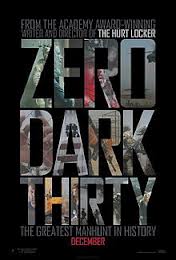
 As I had promised in what seems an age ago, here is my review of Zero Dark Thirty, a film that caused various emotional reactions from me. When I first saw the trailer, last year, it was so ambiguous that it peaked my interest. Then when I quickly learnt that is was directed by Hurt Locker’s Kathryn Bigelow, my heart dropped somewhat. I was not a fan of Hurt Locker. From watching Zero Dark Thirty, I may be persuaded to revisit Hurt Locker but I’m in no hurry. There has been equal parts controversy and praise for Zero Dark Thirty, both in their ways persuading me to bite the bullet (no pun intended) and judge for myself.
Synopsis
For a decade, an elite team of military and intelligence operatives, including young CIA officer Maya (Jessica Chastain), work tirelessly and in secret to complete the ultimate mission: find and eliminate Osama Bin Laden.
Review
I was pleasantly surprised by how much I enjoyed this film. I say ‘enjoy’ because this is a film that one can’t really enjoy because of the subject matter. But what I ‘enjoyed’ about this film is how it showcased Bigelow’s skill as a director of tense dramatic cinema. One point of praise for Hurt Locker was the excellent depiction of a world of warfare, the overwhelming suffocating presence of danger, death, loss and violence. Bigelow brings this and more to Zero Dark Thirty adding a sense of dogged perseverance and desperation to find one man, who had become the poster child for terrorism and the ultimate enemy in the War On Terror.
What brought controversy to Bigelow’s film becomes quite apparent in the opening scenes. The scenes of torture. And there’s quite alot of them. They go on for at least the first 40 minutes or so of the film. While I feel that there is plenty to read about on people’s views of the torture, I will say this. I stick by what I had said before in my Django Unchained review concerning violence in film. Depiction is not endorsement and to be honest although I tend to prefer films where if violence is a necessary compenent to the film, suggestion for me works better than showing but if it is needed to be shown, it doesn’t mean the filmmakers values violence and wants everyone to go out there and try it on each other. People have also come out to criticize Bigelow about not only the graphic nature of the torture depicted but also the apparently misleading view that torture was a key method in obtaining information about Bin Laden’s associates and locations.
With regards to the graphic nature of the torture shown, I’m surprised that people are surprised at it. Even from Hurt Locker, it can be seen that Bigelow strives to give realism to her film and this in particular is a historical drama, it would make the film nothing but uneven if she were to apply such realism to everything else in Zero Dark Thirty but the torture scenes. I fully agree that the torture scenes are long and are uncomfortable but if anything they are needed to not only depict the horror of the situation but to also show the character progression of main character and audience surrogate Maya (Chastain). In the early scenes, she is as visibly shocked and appalled as the audience but grows to believe that it might be necessary for the greater good.
The second part of the controversy concerning the suggestion the film makes that torture was seen as a critical method of obtaining information, I tend to be a little more ambivilant about. I want to believe that the whole film is based on extensive research on Bigelow’s part and she is only showing what she has been told/researched. and the film does attempt to later address the fallibility of false confessions under duress, while at the same time trying to be objective and later show how intelligence gathered that actually led to Bin Laden’s capture. However, because the value of intelligence is not as overtly expressed nor visibly impacting as the torture scenes, this may be the reason critics have decided that the film has focussed too much on the use and perceived value in torture. My personal view is that with regards to time spent of each of these methods, they’re relatively even but it is also possible to see how others might think otherwise.
The story is singularly and pathologically focussed on the pursuit of Bin Laden and like Hurt Locker, characters exist to embody or push forward the central struggle of the story, sometimes for better or worse. Jessica Chastain’s Maya is the personification of this ongoing struggle. Having been put on this job straight from High School she has tirelessly dedicated her whole life to finding Osama Bin Laden, forgoing all life milestones that women go through in that time, such as college life, relationships, finding your place in the world etc. There is a particularly poignant scene before the closing credits that perfectly encapsulates the realization Maya has at the sacrifices she has made. Just by the sheer power of Chastain’s acting, the audience sees this realization and feels the looming of a new desperation that in her life now. Her work has been her life, now that the job is done, what’s to become of her? What is her purpose now? What does she do next? Where does she go? I feel the success in Chastain’s performance is not only in her talent (I have yet to see her put in a poor performance yet) but also in the correlation between Maya’s life and that of Bigelow. Both are women working and succeeding in what is a very “male” arena. Watching Chastain, I feel that this was the first time where I was seeing more depth to a character in a Bigelow film and this may be because Bigelow had a lot to draw from to help her direct Chastain so successfully.
The same can not be said of other characterisations. There are no particularly bad performances, some weird cameos (John Barrowman anyone) but no bad performances. My issue is that Bigelow excels at recreating the atmosphere of war but not so much at creating memorable characters( outside of Chastain’s Maya). This is what put me off of Hurt Locker, and although Bigelow could depend on the excellent performance from the likes of Chastain, I feel that the problem still existed this time round. I could overlook it but it was still very much evident to me. Characters in Bigelow’s films tend to me one-dimensional and as I mentioned previously exist only to push the plot, and while the story was so strong fully developed characterisation wasn’t really necessary and was actually appreciated somewhat (often films fall under the trap of focussing too much on the backstories of characters to give them flesh to the detriment of the main story, see 2011’s Polisse to get my point), I feel without the acting skills of her lead, Bigelow’s did skirt the line of the lack of character development making it harder to feel empathy with the human aspect of what is a very human story.
Final Thoughts…
Surprisingly good. I was riveted from beginning to end despite (obviously) knowing the outcome. Bigelow has really cut a niche for herself as a more than competent director of successful modern Hollywood war films, which is a real accomplishment for what is a “man’s” film in a “man’s” genre in a “man’s” world.
 THE STATION AGENT SPEAKS
I similarly did not care for hurt locker but really enjoyed this film. I am rooting for Chastain to take home the oscar.
And she may very well get it even though I don’t think personally she’s the most deserving. As in my Oscar post Emmanuelle Riva was breathtaking in Amour and if she doesn’t get it then Quvenzhane Wallis for Beasts would be a nice alternative, but this is the Oscars and as good as Chastain was she wasn’t the best in the category but because its a story of importance in American history she’ll probably win it.