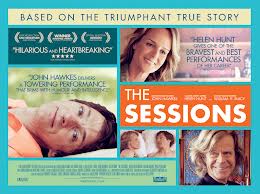
Based on a true story The Sessions stars John Hawkes as Mark O’Brien, a poet who’s paralyzed and lives in an iron lung due to childhood polio. O’Brien in his thirties hires a sex surrogate (Helen Hunt) to take his virginity.
This is going to be a relatively quick review, at least compared to my previous output just because I want to get all my Oscar nominated film reviews in before Sunday’s ceremony. I saw The Sessions on an afternoon after work and wasn’t expecting much. I found it to be both a light funny film that is surprisingly grown up and frank about sex. For me this is a bit of a first because American cinema does not have the most forward thinking view of depicting ordinary sex in film (ratings controversy for films like Blue Valentine comes to mind) and I appreciate the nuance shown on the subject of sex and disability.
To be honest, I’ve never really thought about what it’s like to live in a highly sexualised society where sexual imagery is constantly being thrown in our faces as we go about our day and be then because of a disability be perceived that that disability has killed any sexual drive you may have. Disabled people are often seen as either asexual or invisible when it comes to the subject of sex and this little film goes a long way to state otherwise and it is a welcome entry into the society and sex debate.
The film also succeeds in discussing sex in universal language everyone can understand, disabled or otherwise. I really appreciated the honest, forthright and mature approach, and I thought as I watched the film, this would be a great film for sex ed classes in schools. For this film isn’t just about a 35-year-old disabled man losing his virginity, the film is also about addressing the worries, confusion and feelings that everyone has ever felt about losing their virginity.
The script is based on the works of Mark O’Brien and shows him to be an intellectual poet who was smart, funny and a very admirable character. The film’s success in the script owes much to his work.
The performances overall good were sound. John Hawkes once again, was fantastic (please see Martha Marcy May Marlene for anther inspirational performance from him), William H Macy plays a competent audience surrogate as the priest O’Brien goes to, seeking permission to hire Helen Hunt’s Cheryl Cohen-Greene to take his virginity.
What is surprising is that of all the performances I think Helen Hunt was possibly the weakest and so I am a little stunned at the acclaim that has been solely directed at Hunt. While Hawkes, who as an able bodied actor had to restrict himself to only using his facial expressions and voice to express the myriad of emotions his character goes through has been somewhat shunned. While I’m not suggesting Hunt’s performance was bad, I just think it was the weakest and the cynicist in me suspects that she’s being acknowledged for appearing nude for a large proportion of the film.
The nudity in the film had me feeling two ways. I felt that the nudity on the one hand was far from titillating, just another aspect of the no-nonsense approach to sex. On the other hand, I was perplexed as to why the camera always focussed on the nudity of Helen Hunt and not that of Hawkes. I found this to be quite jarring because throughout the film they were trying to express the naturalness of sex and what comes with it and yet was explicitly ignoring or failing to acknowledge the part of one of the participants. If anything it continued somewhat to perpetuate the whole skewed problematic view of nudity in film. For whatever reason, whether it be for titillation (in this instance I don’t think is the case), vulnerability (you are at your most vulnerable if you are naked in front of a lot of people who aren’t) or artistic expression, American censors are still regimented in their views on nudity, it’s alright or even encouraged for young women to be nude but it’s either pornographic or only acceptable for comedy purposes for a man to be nude. Heaven forbid a film wants to realistically portray two adults engaged in consensual sex BOTH being nude and for the film to be given an R rating. Lest the ratings board member’s heads implode from the collective shock of such a suggestion, everyone knows that film would be slapped with an NC-17 rating And we know that that means problems in cinema distribution. I’m inclined to believe that for this reason the film played it safe and kept the nudity with just Hunt as not to rock the boat with the ratings board which for me lessened the film somewhat.
On a smaller note, if one more person says Helen Hunt is brave for being nude at a woman of her age I will scream! The woman’s not even that old! She 49 yes and she has a nice figure but it’s not a nice figure for her age, just a nice figure. Period. I’ve had it with the condescending disingenuous praise given to women, who don’t the Hollywood-set mould, get for taking their kit off. Any woman, regardless of age are brave to appear nude on screen, because in this judgemental world you’re opening yourself up to all kinds of scrutiny being exposed on the big screen and they are brave for doing it. I’m as sure as hell I wouldn’t do it as most of you wouldn’t either.
My only other criticism of the film was the ending. It was quite obvious then that the last 5 minutes were not based on O’Brien’s essays like the previous 90 minutes or so, but instead felt a tacked on Hollywood ending filled with tear filled meaningful glances between women who aside from each knowing O’Brien in various capacities would not have any real connection between each other. I think the film was trying to express the acknowledgment between the ladies that they had all known intimately (whether physically or emotionally) this one special person and they were bonded in some way in that experience, however, for me it felt tonally incompetent compared to the rest of the film and tacked on.
Last Thoughts
Despite the Hollywood ending, this film was thoroughly enjoyable and if you missed it in the cinemas then don’t worry, I’d recommend this as a sound DVD purchase. There a films made for the big screen and films that can be more appreciated at home (please note: for the latter, this does not make it a lesser film) and this one is for a night in with a glass of wine.
 THE STATION AGENT SPEAKS