Is there a term to describe someone who seems to shy away from his or her’s own culture? What’s the word for that describes the opposite of xenophobic? I’m not trying to get philosophical or deep. I’m not going to come out with some big revelation. I’ve just realised that most, if not all, the reviews I have published (and some that I have notes for) have all been American-centric. Over the last few days I have been really wondering why. I like to think my film taste is rich and eclectic. I love any good film from anywhere. All requirements needed is that it is good. So why do I feel I don’t watch as many British output as I should?
I really think it’s down to the kind of cinema being produced in this country. Without going into excessive detail about where I think my identity lies being Black British and please excuse me if I sound like I’m generalising a tad but I honestly feel that the films being made today in the good old U of K just don’t connect with me too much. I am a forever faithful of British Cinema from the early 20th century, with the likes of genius of Powell & Pressburger (Red Shoes, Black Narcissus, A Matter of Life and Death) and I like the idea of Ealing Studios. I have a soft gushy spot for films like A Brief Encounter. It seems however, that when American Cinema evolved into the grimy, gritty dramatic method cinema of the 70s, british filmmaking jumped on board that train and just never seem to have gotten off. Please don’t mistake me, there have been a number of gems, over the last forty years that have highlighted the talent that is in our midst. Trainspotting, Shallow Grave, Withnail & I, Shaun of the Dead, Hot Fuzz and last year’s Weekend and many more that have amazed me.
But in the grand scheme of things, these gems are few and far between. British cinema seems to be comfortable producing one successful film every couple of years as if that’s competitive enough to hold a crown to the US.
My other issue is quite simply there only seems to be two types of film that comes out of Britain regularly (excluding the likes of James Bond and Harry Potter franchises) its either grimy estate drama or posh people ‘comedies’. Stories about two groups of people I have nothing in common with and I think there are many more people who would agree. British cinema seems incapable of supporting films about the ordinary British citizen. It seems complacent and happy to basically trot out bleurgh characters who have no sense of identity at the end of the day beyond fitting into the two extreme ends of the class spectrum.
Working and attending many a british film festival, I know for a fact that there are films being made that strive to represent the alternative, your ‘Joe Average’ British Citizen. A good example was recently at the London Shorts Film Festival. After watching a strand of shorts about love, the general consensus was that one short that stuck out the most and was the clear favorite of the panel and the audience was one about ordinary people. They were black or of Afro Caribbean descent but they were portrayed as ordinary intelligent people living in decent homes living decent lives, fully fleshed characters that the majority of the audience relates too, not placed on the council estate running to or away from violence which was the usual fare.
However despite the popularity of the short and the refreshing perspective, the cynicism in all of us knows that any big wig studio executive would have an almost opposite view to this. That the only way this movie would ‘sell’ would be to for everyone to be recast. Because after all, everyone knows that only thing ethnic minorities in this country and the working class know is poverty, violence and desperation. People like that can’t know or experience things like love, understanding or real human connection. Woefully inaccurate stereotypes/generalisations is what’s sexy. That’s what sells.
As a result of this, I do tend to avoid the general output if British cinema, deliberately avoiding estate dramas (I’ve never seen Kidulthood or Adulthood. I can see the point of why they were made, especially the story of the filmmaker’s struggle to get work in British film) but in my view and you are very welcome to disagree, these films serve to really just perpetuate stereotypes that we should be steering away from. I also have equal disdain for the so-called comedies about middle class or inexplicably rich people who do jobs that I know for a fact make HARDLY NO MONEY and yet money seems no object (think Love Actually, and any other “Best British Comedy of the Year piece of garbage) that are so out of touch I wonder if David Cameron was a consultant on these films.
All of this turning my nose up at homegrown talent does get me down sometimes as there are some filmmaker’s work out there that always intrigue even if I don’t always like what they produce. So I made an effort over the last few weeks to watch some British film about British people in the hopes that this really really long slump we’re is showing signs of being over.
So here are three films, one of which I rewatched recently, that I have seen over the last couple of weeks:
Spirit of ’45 (2013)

I went into this film noticing two things; the first being that I was definitely the only person in the audience under the age of 60 and secondly that this documentary, by Ken Loach, was definitely a propaganda film for Labour. Not that that was a bad thing, just something I wasn’t expecting. I had thought the film was going to be an exploration of the rebuilding of Britain after the end of World War II. Instead, I was treated to the history and the philosophy behind the creation of the NHS and the growth of socialism under a labour party to try and address the divergent gap between the rich and the poor and to raise living standards of all British Citizens by providing them with free healthcare, habitable homes, unions, and publicly owned gas, transport and electricity. The film steps into propaganda territory by talking about how Thatcher’s government dismantled all this to the level that we are still feeling the repercussions today. This I agree with and while they briefly touched upon the tactics used by the likes of connected labour MPs who were not that far different from the Conservative “Enemy” the film is really quite one sided.
However, it was terrifically interesting, and it was nice to see actual working class people as they were once known, hard working passionate individuals fighting for the right to be recognised as people, just like the ones in power. I felt I related to them much more than the current representations in modern British cinema or TV.
Broken (2013)
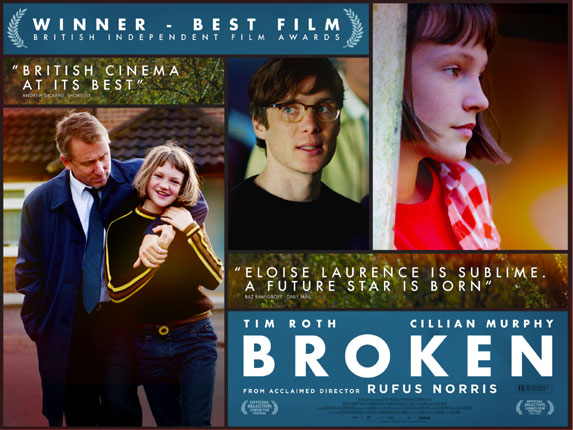
A more realistic, British Precious? Let me explain myself better. 2009’s Precious as a story is terrible. As mentioned in my Once Upon A Time When We Were Coloured review, The Colour Purple has a central character that is constantly put upon with more problems, obstacles or abuse than any decent human deserves. The character is less of a person than a human life sponge soaking up all the horrors of the world just so at the end we can all say she survived and didn’t turn into a raving lunatic in the end as any decent human should and would do. I thought Whoopi Goldberg’s character got it bad! She’s living the easy life compared to Gabourey Sidibe’s Precious. The sheer amount of metaphorical (and physical) punches to the face this character got made me angry at the film. The ONLY saving grace of this film was the incredible acting and I’m glad there were acting prizes awarded to the cast but then I get angry again once I realise that that means that film won prizes. I feel such vitrol distaste for this almost voyeuristic abuse of certain film characters. I call these instances Precious moments, and it’s not as a compliment. My heart literally sinks when I am presented with a film that might have a few Precious moments.
For a while I thought Broken might be like that, especially considering it was set in perpetually overcast England. But I was pleasantly surprised. I was first happy to see Tim Roth, not only in a British production (kudos to him for making a distinguished career for himself in the US) but as an ordinary, decent man. For I was struggling throughout the first half of the film to remember when I’d seen him play an ordinary decent man and I realised I’d never seen it. He’s played a criminal in a smart suit (Reservoir Dogs), a racist skinhead (Made In Britain) and other assortment of baddies and general psychos, so I’ll be honest, I was waiting for a good proportion of the film for him to freak out and not commit mass murder. It was nice to see not commit to the norm and not do that.
Roth plays the lawyer father of the lead, played by newcomer Eloise Laurence, who I must say was quite a revelation. She plays a young girl who life is changed after witnessing a violent attack between neighbours in the cul-de-sac she lives in. This is a combination of a touching coming-of-age story, neighbourhood drama with a sprinkle of psychological thriller thrown in for good measure. It’s also a decent critique or look at a modern british neighbourhood, where the working class (some trash, some good) and well-off live side by side and lives bleed into each other. A much more honest representation in my opinion. I really enjoyed the film, the performances and even the contrivances (there are some concerning one family and the daughters, where I felt there were a few Precious moments threatening to derail the story)
Sightseers (2012)

This is the film that I first caught back in 2012 at a press screening for the BFI London Film Festival and one that I re-watched recently now that it’s out on DVD. It’s a very black comedy about the budding romance between a psychotic serial killer and a sheltered woman as they embark on a road trip around Britain.
First thing I must remark upon is that I haven’t seen a road movie like this, where the beauty of the British landscape is celebrated with such affection as the art/doc Gallivant (please check out. It’s really touching and affecting as well as poetic).
Road movies are things I associate with the US just because the landscape is so varied and the land mass so huge. But this film showed that is variety and beauty too in Britain. Almost made me want to go on a British road trip. As long as I don’t have to go with these two loons!
And they are both loons. What makes their characters so unsettling is that this lunacy is grounded in normality and traits of normalcy in their personalities and day to day lives. I personally could see myself in some of their behaviours, the kind of ordinary person pushed to the edge by society thing. Like a less stylized Falling Down if you will. Chris is definitely the Michael Douglas character, the ordinary affable boyfriend of Tina who just so happens to snap and kill rather than count to ten and take deep breaths when confronted with annoyances or…people in general. I don’t want to give too much of the plot away but Tina is not so sane herself, but her crazy, I think, is grounded in her love of Tim, her saviour from her arrested development life with her mum.
This is a film that I enjoyed much more upon a second viewing. I had kind of enjoyed it the first time round, but with some strong reservations about the film. I was definitely in the minority at the time as the film was a festival favorite. Not from any form or peer-pressure but the acknowledgment that the film went at a reasonable pace and I was never bored the first time round, I watched the film a second time and nearly all my previous reservations had vanished. I think at the time, the film just wasn’t what I was expecting and the comedy a bit too dark for me at the time. Upon second viewing, I loved it. The characters are well developed and layered and a performance by Alice Lowe as Tina that I thought initially was uneven, is actually near flawless. She reminded me actually of Naomi Watts in Mulholland Drive.
The whole film I think is a weirdly very British fare. Its deadpan, chilling comedy, both deliberate in moments of embarrassing awkwardness and equally confident in character, story and pace. All with a fare bit of brutal gore. As schizophrenic as this all sounds, the film strangely is not. It has a steady foundation and plot that it never wavers from. I think that thats because its made in Britain for British comedic sensibilities and I think thats what it was such a hit.
I haven’t seen Ben Wheatley’s Kill List, but I am intrigued now. Although I do think I need to have a strong stomach judging from Sightseers. Regardless, its refreshing to see British Cinema being celebrated for bucking the general trend and being British instead of bland, palatable fare primarily targeted at American audiences. The success of films like this and the successful export of very British TV I hope is turning the heads of British film industry heads that there are diverse, rich characters and stories to be told, that will draw an ever growing ever hungry but currently ever invisible film audience.
Overall thoughts:
When I started to explore the topic of British Cinema, I felt disenfranchised. I couldn’t stand behind what I saw as air-headed dross. just waiting in hope to be pleasantly surprised by the offerings of the likes of Edgar Wright, Danny Boyle, Richard Ayoade and Andrea Arnold. There are plenty of British filmmaking talent abound but it seems that sometimes even having a distinguished body of work doesn’t make a director exempt from having to produce crowd friendly blandness. Not every film has to have a strong message, or be completely innovative. Sometimes, treading on familiar ground can be comforting like a warm blanket, but too often the ‘familiar’ constitutes depending on lazy and harmful stereotypes that serve more to alienate home audiences than entertain.
I sincerely hope that the three films reviewed here that I would fully recommend to you all shows a much welcomed change in tide for British filmmaking and the usual fare being offered loses their place as the dominant offering and film like these three become more of the representation of the innovation that exists in modern British filmmaking and storytelling. At least here would be a good start…
 THE STATION AGENT SPEAKS