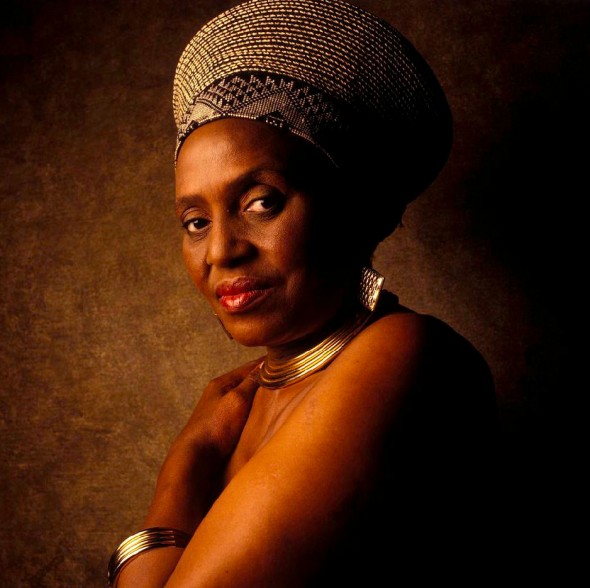
Little back story.
Back last year while working for a small film festival, our small team embarked on a doomed project to obtain Mama Africa for our Opening night film. Alas it seems we needed this pesky thing called money, which we didn’t have enough of to screen this important film. It was a bitter disappointment so when I saw my current place of work was screening Mama Africa in what I consider to be one of the best theatres I have ever watched a film in, I lost my usual composure a little and squealed in delight as I bagged some tickets and dragged my film buddy along. I sensed that this was not a film to miss. I felt that an innate connection to the subject: a woman who gracefully represented a true soldier of peace in a real African sense.
(Interesting factoid…well for me anyway. You know that theory of six degrees of separation with Kevin Bacon – how every person on the earth can connect themselves between six people and less? Well I’m one degree of separation from Miriam Makeba in the form of the great man Harry Belafonte, who brought Miriam fame in the United States, and with whom I had the great pleasure of conversing with for fifteen minutes in 2011 at a film festival. That was far most the most star-struck I had ever been. I think the might have thought I was a little…special as I grinned stupidly and forgot words for a good five minutes before I managed to calm a little. Have had no such reaction to anyone else since. Not even George Clooney.)
Before I proceed with the review I want to make a shameful admission. I wasn’t entirely sure who Miriam Makeba aka Mama Africa was up until I was asked to pursue the film for the festival last year. There are many gaps in my knowledge of my ancestral history of which I am constantly trying to fill but as Nigeria (my heritage) is a big enough place in itself to learn about the rest of Africa is a daunting subject matter. One that I relish conquering but still an area that continues to leave me a little nervous and frequently in a position of embarrassment when people drop names of important people that I either know of fleetingly or not at all, particularly outside of the West African stratosphere.
In my defence, I have noticed in my near decade of living in London and being surrounded by many cultures and languages that for some reason many people assume that I am from anywhere but Nigeria. The top five places that I get told I’m from:
1) South Africa
2) Mixed race – some ambiguous mix of white and something else
3) United States (?!)
4) Jamaica (?!)
5 Cuba (??!!)
Despite me not harbouring any kind of accent, cultural inclination or general vibe that I am from these places, I often get a surprised look when I explain my heritage and more often than not receive this reply in response:
“Wait. Are you sure? I could have sworn you’re from <insert random country>”
Regardless, learning from my mother who always experienced this, and still does, I’ve taken to laughing off such behaviour. I also see it as an opportunity to learn about the places I’m more likely to be from than the one I am. South Africa is a big one for me just because of its volatile yet rich modern history. I had brushed up on my knowledge of apartheid through the usual books etc but also via a devastating exhibition held at the Barbican recently. But like the rest of African history, I know that South Africa isn’t all about that one terrible period of history, and if one is to focus on that then at least explore the extraordinary people who emerged from it. Miriam Makeba was one of them.
The Review
The screening was introduced by June Bam-Hutchison, author, academic and rights campaigner, who herself was a teacher living in apartheid labelled on her birth certificate as mulatto and consequently a second class citizen of her country of birth. Her passionate introduction, exhibited the importance of the work of this woman to June, who since her passing in 2008 has been somewhat downsized to a successful singer who happened to be associated to the ‘real’ civil rights campaigners (i.e. men) like Harry Belafonte, Nelson Mandela and Stockley Carmichael. When really it was evident to South Africans like June and Nelson Mandela, that her songs had the power to resonate with he rest of the world and to finally take notice of what was happening in South Africa.
All these iconic figures Miriam encountered at some point in her life recognised this, as does the film. How can someone suggest that this woman did nothing besides be a popular singer when she was exiled from South Africa for over thirty years and was the lone person to approach the UN and call for the need to sanction the South African government, and be one of the first people Nelson Mandela demanded their expulsion be lifted when he became prime minister. Pretty eventful life for just some entertainer?
The film itself is competent in its pacing and style. It’s informative, lively and mixed in with captivating performances of the lady herself. As the film was made after Miriam’s death, I was momentarily concerned that like some documentaries, the viewer won’t really get to know the subject if you the focus is just interviewing the people who once knew them. I’m thinking of the documentary Dreams of a Life (this might not be the best example as the premise of the film is the vague memories of a once popular woman becomes so isolated and invisible that she dies alone undiscovered for three years. Nevertheless, the lack of the personality of the subject coming through because of the vague recollections of people who hadn’t known the woman for nearly decades made viewing this film once of the most frustrating experiences ever).
I needn’t have worried because like Senna, another documentary about a famous figure compiled after their passing, the film had access to plenty of footage of Miriam and her life, including interviews throughout her career and home videos with family, band and friends, recreating a Miriam that is rich and solid. Combine this with the film interviewing people who knew her intimately (i.e as mother, wife, band leader and friend) including her beloved grandchildren, I really came away with a sense that I knew this woman (it also helps that in her older years she has a striking resemblance to my own mother).
The film spans the whole of Miriam Makeba’s life, quickly establishing the singing talent she had inherited from her mother and her rise to fame in South Africa, to eventually her innocuous involvement in a documentary called Come Back Africa that eventually led her 30-year exile. As Miriam led an eventful life that spanned the four corners of the world, its inevitable that some parts or points in her life would be rushed over. My only criticism of the film is that some parts that I thought really interesting or important to telling her story is only superficially touched upon or not fully explained. A clear example is the terrible tradition of apartheid that Miriam devoted and sacrificed to see stamped out. I know well enough that the full destructive impact of apartheid is not fully explored in the film because the much of the audience who would seek this film would be of a generation that knows too well what dire effects apartheid had, many of them living it. However, I thought it would have been nice to spend a couple of minutes at least going further into a system that could allow the exile of the country’s most famous singer and the 27 year-long imprisonment of its future prime minister. At least for the younger generation or audience who never had to live through apartheid.
However, because the film has so much to tell, I can understand making an assumption about the audience’s knowledge. Another part in the film I felt was rushed dealt with the personal tragedy that befell Miriam later on in her life. I know that the film didn’t want to exploit this sad time in her life, nor focus on it, instead the film being more of a tribute to her singing career and activism. However, that part of the film felt almost ominous and more conspiratorial than the actual story is because of the lack of details and noticeable sense of rushing that part of the film. These little criticisms however, didn’t diminish the sense of the person of Miriam, her fame, her quiet power, grace and popularity is celebrated justly in this film.
The film aims to portray Miriam as what she was – Mama Africa. She was a figure that was both mythical and extraordinary in stature, but she got there with the quiet grace and determination of an ordinary African woman. She managed to speak to people in the most purest and powerful forms – through song – and I have to mention here that the music is good. My friend and I vowed to immediately get on iTunes and download as much as we could afford (in my case jut the more well-known songs). I was surprised to learn as soon as the Pata Pata song came on in the early part of the film that I knew the words. It was a song the I had loved when I was a toddler living in Nigeria. Besides the popular sounds of Pata Pata and the Click song, Miriam sang social conscience songs that helped expose the plight of Black Africans and the fight of individuals like Nelson Mandela back home and I think brought South Africa to the conscience of the world. Without Miriam Makeba’s influence, one wonders where South Africa might be today. That is how important the film views her influences.
What is remarkable about Miriam’s story is the underlying sense of sorrow she felt being exiled from her home, yet it didn’t stop her having hope and it didn’t turn her into a bitter person. If anything she continued to be a giving individual seeing the whole of Africa as her home but South Africa as where her heart was. Through her songs and with great pride she endeavoured to teach the rest of the world the rich tradition and culture of Africa and I think she had a hand in changing certain perceptions of Africans all the while longing to go home.
She eventually was to return home but her return was bittersweet. She found that the idealistic hope she had fought for where there would be a new Africa, independent from colonial interest and united, was instead by her return, introduced to an Africa that was mostly independent from overseas rule superficially but governed and run by neo-Colonialists trained to serve only overseas interests. The most poignant part of the film is the very end, highlighting the film’s success in taking the audience on a journey with a woman who in the beginning I knew very little about to at the end sobbing as we watched her very last performance, knowing that moments after she left the stage, Miriam collapsed and passed away.
Overall thoughts…
The film itself for the most part is successful in its structure. It is fresh in pace and even in style. Nothing overwhelms it. There’s never the sense of too much talking head, nor too much musical interludes, it’s all very well-paced. This is undoubtedly a tribute film, so it its inevitable that the film is strictly subjective. It aims to celebrate its subject, highlighting all the good Miriam did and ignore all if any controversy surrounding her.
Its joyous affection for the subject matter is abundantly clear, but what really elevates the film is the subject matter. Miriam Makeba is a woman who has become a new fascination. A remarkable woman who through the simplicity of song did so much for her country. A true patriot and a true woman of grace and talent. The film was a bittersweet experience for me because this is a woman who I will sadly never get me yet coming out of the film I felt I knew her. Maybe it’s for the best…I imagine it’d be Belafonte all over again.
Up next….Springbreakers. The other end of the filmic spectrum. Keeping it interesting!
 THE STATION AGENT SPEAKS