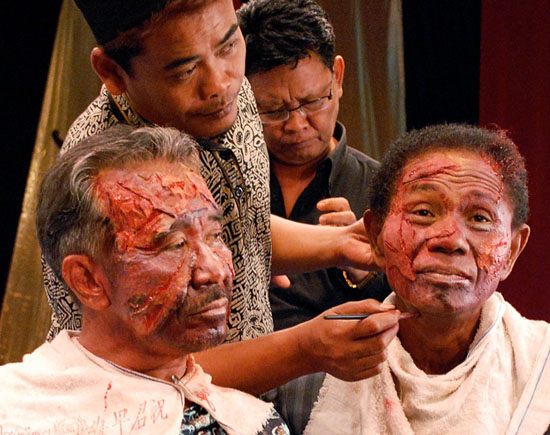
Adi Zulkadry (left) and Anwar Congo (right)
I’d really like to say I’m joking with my tagline but alas I’m not. The Act of Killing is as powerful as the hype has claimed. However is it a masterpiece? I’m not sure. It is however a thought-provoking and memorable film indeed. It’s set-up as equally interesting as its protagonists, men who in their youth were street thugs selling black market cinema tickets, were hired by the government to head Death Squads in North Sumatra during the Indonesian Killings of 1965-66, who now as old men are asked to reenact that time in history in any way they see fit.
The film has one of those rarities where the subject matter is so formidable and mesmerizing that for the camera to just follow that alone a remarkable film can be made. But the film goes beyond laying out from its openings that the film’s focus is not about the atrocities of nearly five decades ago, but what happens when these perpetrators of such crimes still revered in society, their crimes unchecked and the rewards for their actions still flowing to this very day. What are the effects of the skewed moral compass of institutions on an individuals and society as a whole?
It appears that propaganda is a powerful thing and pervasive. The regime or train of thought that controls Indonesia it seems even now, has created a force that keeps the survivors of the killings silenced, the general public brainwashed into believing that what was sanctioned was for their benefit and the perpetrators heroes. This is ever pertinent the opening scenes of the film where the protagonists discuss their eagerness to reenact their activities of 1965 in a film to “keep the history of what they did alive”. This sanction of murder and terror has created a comforting bubble in which these men live in. Society hasn’t deemed their actions as wrong, quite the opposite in fact, therefore they are able to live with themselves and even celebrate their actions, in Anwar Congo’s case, that is killing around 1,000 people, mostly by strangling them with wire. Apparently wire is the quickest, most efficient and least messy way, making him on the most notorious leaders of the Death Squads as pleasantly explained here:
This scene is our introduction to main protagonist and I must say it was one of the most unsettling experiences I’ve had in a film since I sat down completely unprepared to Dear Zachary: A Letter to a Son About His Father (another documentary that needs to slapped with a propensity to traumatise sticker), from jovially explaining killing techniques to dancing in minutes I thought this kind of person can’t be real. How is he walking the streets when he’s obviously a grade A psychopath?!
Because he’s allowed to. He’s encouraged to. His society, his culture has rewarded him, encouraged him. Placated him. Justified him. He is a product of his community. Again the propaganda weaves its magic, helping Anwar and the others to live with themselves.
Although the film does feature other state killers besides Anwar, it’s quite obvious that the director Joshua Oppenheimer has built a special connection or interest in Anwar as the jovial old man who initially is eager to reimagine his youthful crimes, soon uses the situation to less boast about his past (interrogation scenes filmed in film noir, World War II style, B-movie gory scenes and weird musical fantasia set in lush surroundings in the style that reminded me of stills I’d seen from Uncle Boonmee Who Can Recall His Past Lives) than for it to become his confessional. Despite his rewards and his outward appearance and manner, he is a haunted man, who by the film’s end is literally trying to vomit up his demons. It seems the film tries to say tentatively that there’s hope in the human conscience yet.
The same can’t be said for some of his other former comrades. Some of the most disturbing (there were many) scenes included the flippant way in which a journalist describes how he provided victims, one of Congo’s cohorts happily explaining how he wanted to elected mayor so he could be free to extort the local community (he didn’t win, thankfully), people openly threatening and extorting terrified Chinese traders, and perhaps most disturbingly for me, the same dude after reenacting the burning and pillaging of a village, happily reminisces with old friends about the good old days of raping young girls.
Despite the total alien attitudes these men have to killing and terror they committed the film goes to great strains to show these men as human. Human beings capable of such unspeakable acts but behind the bravado and the vocal righteousness of what they did:
http://www.youtube.com/watch?v=zJ5_JAgoZ5Q&feature=player_detailpage
A revealing mirror is created. The Indonesian Killings was backed by western countries the fervent fight against Communism and as Adi Zulkadry comments, ” War crimes are defined by the winner”. In this case, he sees himself as the winner and therefore completely free of guilt and fully prepared to go to answer war crimes in Geneva if needs be (This slightly smacks of bravado however. There are a few tell-tale signs that suggest otherwise). His comments and the film in general raise interesting questions about our own society’s reluctance to look and actively punish our own national crimes (e.g. Britain’s backing of the Biafran War, Kenya and India etc). These kind of atrocities are not restricted to these men nor Indonesia, it is entangled in human history and continues to repeat itself.
This bizarre, powerful film somehow ends as bizarrely and powerful as it began. It reveals how the actual act of killing is simultaneously a banal yet profoundly destructive act.
Would I recommend this film?
My feelings towards the film are a paradoxical as the film itself. I would recommend it because apart from the last line from this quote from producer Werner Herzog:
“I have not seen a film as powerful, surreal, and frightening in at least a decade… it is unprecedented in the history of cinema.” – Wikipedia.org
I would recommend for this reason. As a film to enjoy? Not so much. Obviously it wasn’t made to be enjoyed. It did leave me feeling sick and for this reason I would fully understand if people were deterred by it.
Oh and the film is a bit of an endurance test at two and a half hours. I believe there’s even a longer cut. While captivating the long running time might about such a disturbing subject matter might prove too much for some. I definitely won’t be seeking out the longer cut.
Where can you see it?
It’s still showing at certain cinemas here in London and it looks like it’s made the rounds enough that it will get a DVD release.
 THE STATION AGENT SPEAKS