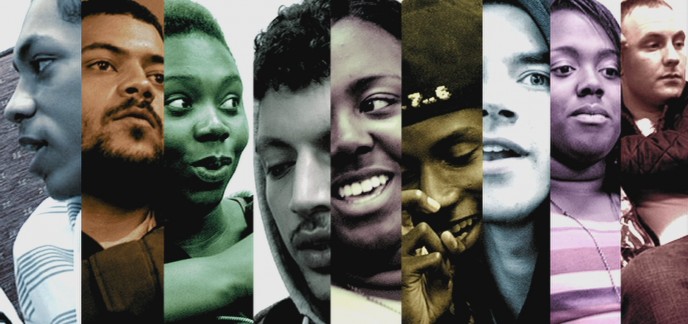
The following review is rather special for me. A bit of a milestone if you wish, for it’s my first foray into guest reviewing for someone else. I am privileged to have been asked to review Riot From Wrong a special screening held last week at Genesis Cinema as part of Urban Screen and B On The Pulse partnership screening. Details of both organizations and the film’s distribution details to follow at the end of the review.
This screening also had a lengthy Q&A with some of the filmmakers, participants in the doc and a shop owner whose quarter century old family business was devastated by the riots. I mention this because the Q&A gave a really good glimpse into why the doc was made as well as the significant impact of the events of 2011 that still have repercussions to everyone involved. Myself included. Quite a bit of my review is therefore influenced by some of what was discussed after the film.
Ah. The Summer of 2011. Four days that will surely go down in infamy? You’d think so wouldn’t you? Not if the government nor the (government controlled) media can help it. This is the basis for why this first time feature documentary Riot From Wrong exists. As a relative outsider in the sense that I was there in London at the time of Mark Duggan’s death and the subsequent riots that followed but neither a participant nor a victim directly affected by the looting and destruction of businesses and homes, I can’t help but agree that there has been an active campaign to sweep the events of two summers ago under the carpet.
As a talking head observes at the end of the film, one is equal parts moved by the poignancy of thousands of Londoners out with their brooms vowing to clean up their community together in the aftermath of the riots but also aware of the symbolism those brooms hold of everything being swept under the carpet. I kind of agree with that sentiment. After all, the Olympics were to follow in less than a year and the government fully aware that all eyes were on the nation pulled out all the stops to get rid of the stench of dissent left behind. The extended prison sentences handed out to the thousands apprehended by police, and the barely acknowledged one year anniversary, the blanket silence about the ongoing wait for compensation for the businesses and people destroyed and most poignantly the forgotten names of the five people who died during those four days (Trevor Ellis, Haroon Jahan, Shahzad Ali, Abdul Musavir and RIchard Mannington Bowes) clearly demonstrates that the powers that be relegated 2011 to a dark blip to their ongoing war on poverty. When I say War On Poverty, I’m not referring to that campaign of a few years ago, where everyone (myself included) wore plastic wrist bands in wistful attempts to address and destroy world wide extreme poverty. I’m referring to the Harry Belafonte definition (please watch or read Sing Your Song) of the persecution and punishment of the Poor by the Rich.
Could it be that if they were to address what happened then, it would mean assuming some responsibility not just for what happened then, but before after and especially now? This is what this documentary attempts to address. The idea that the Riots didn’t just come out of nowhere, not solely as opportunity to run rampant (although some participants admit that looting became a paradise for opportunists) but a deeper reason (even for the opportunists) as to why people would see fit to destroy their own communities. Why were people driven with such anger that they literally watch their world go up in flames?
Riot From Wrong shows a valiant attempt to answer these questions but it’s not a wholly successful one.
For me the most interesting, kinetic and powerful part of the film is it’s excellent beginning. There is live footage and commentary about the still mysterious circumstances surrounding Mark Duggan’s death. For readers unfamiliar with the back story, Mark Duggan,a 29 year old Tottenham resident, was shot by police on August 4th 2011. He was apparently under surveillance and suspected of being in possession of a hand gun. Just like in the reports of his death by the media, the documentary recreates the confusion and suspicious circumstances of his death. Done much better by this documentary, than the much more experienced media is the explanation of the police’s behaviour after the shooting. The lack of communication and response from the police to Mark Duggan’s family led to a public and peaceful protest by the Duggan family and Tottenham community. However, the continued lack of engagement from the police, who for some reason didn’t feel the need to inform the Duggan family of the death for a nearly two days fuelled the flames of an imbedded discontent in an area where the relationship between the Tottenham community and police could be likened to that of an uncommunicative and violent marriage heading straight for the divorce courts. It seems inevitable now what followed after.
The frenetic pace of the footage shown, the passion of those on screen in the first 25 minutes of the film clearly earns this statement from journalist Dan Hancox, author of Kettled Youth”:
“One thing I learned from Riot From Wrong is that 14 young people can get closer to the truth than 90% of working journalists”.
Comparing this part of the documentary to the reporting of the Riots by mainstream media outlets, it’s devastating how much this assertion rings true. I remember at the time how much colleagues and everyone around me immediately shunned major media reports when it became very apparent how much misreporting there was in these outlets. A major one came quite early just after Duggan’s death when it was reported that he supposedly shot at police first hitting an officer (it became clearly quickly that the officer had been shot in a case of friendly fire). The most telling piece of misinformation that the media seemed to want to will it into public conscience until it was true was that Mark Duggan was a gangster with a criminal record. Now I don’t know whether he was mixed up in gangs or why he bought a gun, but what is fact was that he didn’t have a criminal record. I’m not saying that a lack of a criminal record makes someone an angel, but it does refute the media’s campaign to besmirch a man’s name to justify what happened to him. What makes this situation more frustrating as the film states, once the media realised that this image of Mark Duggan created was in fact false or at least based in hearsay, instead of doing the correct thing and apologizing they then accused the dead man of being a philanderer. Because being a womanizer justifies being shot to death by police. I never knew that.
Now again, if he was that, it’s behavior I do not condone. I abhor it in fact. But that still doesn’t justify the results. It seems that Mark Duggan was a victim of racial stereotyping. He can’t just of been a victim of overzealous policing, an operation gone wrong, he had to have deserved it some way. Because after all if you’re black there has to be something criminal about you. If you think I’m exaggerating, look into the Stephen Lawrence case and his family, look into the different cases of deaths in police custody. This anger, is aptly and capably documented in the documentary, with appearances from community leaders, residents who have lived amongst previous riots and periods of tension with the police. Articulately identifying their frustrations at the lack of progress and cyclical behaviour of both the police and the communities particularly the youth.
I was most enraptured by the accounts of the participants in the Riots. Their actions inexcusable but their reasons strangely compelling in their honesty and to some degree understandable. The doc does an excellent job in creating a candid look into the thinking behind the looters to reveal that this kids (and the looters in this documentary are practically children) are not so different from the rest of us. It’s easy to paint them as feral youths with no ambition or need for anything other than trainers and technology. In reality many of them are as aspirational as the next person, with the same desire to do things like get decent jobs to provide for their family and as one looter said
“To put a smile on the faces of those they love”
Many of them remark on the fact that they looted not because they wanted any of the things they stole (one remarking that he took a Harry Potter box-set despite having no interest in the franchise) but as a misguided collective finger to the government. They didn’t see it as stealing from their community and people like them who worked hard to build up their business but as an attempt to demonstrate the detrimental affects of government cuts on its people. I have to note that at this point in the doc, memories flooded back of the tough disciplinarian role David Cameron adopted in the wake of the Riots about how he was going to hand the harshest of punishments to its participants. Which at the time (and still does) made me laugh as it is well known Cameron was part of the notorious Bullingdon Club that until very recently was well known for trashing and looting businesses for shits and giggles ya! But that was okay because they threw money at these poor business owners and it was for shits and giggles anyway, not to make a (admittedly very misguided) statement.
The doc suggests that for the Youth the cuts run deepest. Especially youth from struggling families. Youth orientated services are getting massively cut, as are public services such as libraries. University fees have increased to freeze out aspirational poor youth so that young people are leaving school under-qualified for the few jobs that are there. Finally those who do manage to get to university come out with no jobs available. It’s a vicious existence they live in. And they’re continually told to:
“Shut up. Sit down and take it”
Some of the above reasons are looked into to provide explanation between the growing rift between the police government and media on one side and the youth and other participants of the Riots on the over. In amongst the look into the effects of government cuts on young people, the doc looks at the police controversial use of Stop and Search (which involves a lot of racial profiling and vilifying of young people particularly black men and the initial reasoning behind the Riots), media saturation of the image of the individual, consumerism and Thatcherism as well as the conflicting message the government sends to its people, taking the money out of the public’s pocket to help irresponsible bankers and big businesses and more importantly themselves (expenses scandal anyone?).
It tires me out even typing about all the tangents the doc explores and as one of the filmmakers expressed in the Q&A, the doc was intimidating in scale because each cause of the Riots that they looked into could have served as a documentary on its own. And therein lies the problem with this film. As previously mentioned, the initial 25 minutes of Riot From Wrong is a raw, explosive passion project from youths who were involved (not participants in the Riots but guerrilla eye witnesses). Angry at the media portrayal, they took it upon themselves to take cameras to the streets and document the truth as they saw it. To articulate on behalf of the disenfranchised who couldn’t articulate for themselves, their anger and frustration at a situation they felt was out of their hands. The eloquence is evident as they allow all different types of people to articulate the confusion, shame, anger and hope from these events is particularly potent, however once the documentary attempts to look into the causes of the Riots and youth disengagement, the intimacy and urgency of the message is lost because the focus of the film has been lost. The more interesting principals are relegated as bit part players in their own story.
The filmmakers stress that they wanted to make a film that gave a voice to the voiceless about a situation that was equal parts inevitable and devastating. However, they don’t stick to that reasoning and the results are an uneven film. What proceeds the first impressive third of the film is a somewhat generic (although technically accomplished) social documentary. Instead of the words of the people on screen driving the doc, giving it its passion, the film relies on flashy animation to deliver us statistics and opinions of ‘experts’. The effect for me was that I started to lose interest because the heart so evident moments before had been lost to empty statistics and abstract opinion. I also felt that the opinions expressed were so one sided in what I like to call the ‘Michael Moore Effect’ that the sympathy created was slowly being chipped away. The documentary was turning into a Spirit of ’45 for 21st century England. (Not that that’s necessarily bad. Come to think of it, I don’t think we have a decent or honest expose on working class life in the c.21st. However it was a misplaced distraction here. Another doc for another day).
Even if I agree with the general sentiment of what I am watching, when the selected ‘facts’ presented verge on manipulation I lose interest quickly. I felt as if the audience was being hit over the head one sided speculation and causative links when the audiences interest lied with the personal effects the riots had on individuals communities. It seemed like the film didn’t have confidence in relying on the articulate reasoning provided by ordinary individuals in earlier parts of the film and using the statistics to support them. Instead it’s the other way round and it weakens the film. I think this film would have been elevated to very good to outstanding if it had perhaps followed the looters, victims, community leaders etc and exclusively following them in the aftermath. How did they recover, come to terms with, repent even from the activities of that summer? The audience never finds out.
The ending is a well-meaning yet strangely optimistic with the country’s capital coming out in droves to help clean up devastated communities. I say it’s a strange ending because it’s completely at odds to the reasoning behind the making of the film (the Riots have been barely acknowledged since they happened).
Even the director admits that things have gotten worse for these communities and will continue to worsen (the government’s bulk of cuts are set to bite particularly next year) before any signs of reprieve. Despite the tone at the end of the film, this is an ongoing issue of which solutions have yet to be found. Not that it’s the documentary’s position to provide solutions but it is interesting that in an effort to follow narrative structure (beginning middle end) the filmmakers have fallen into the same trap as their accuser’s, documenting 2011 as a one off occurrence.
During the Q&A, there were a few comments about the detour the film takes and one member of the audience commented on the strong anti-government rhetoric tones of the film’s message of the latter part of the film, suggesting that it was detrimental to the film’s cause suggesting that the government can’t be reasoned with so there’s no point in attempting to deal with them. The audience member’s point being that progress can only be made if there is dialogue. Essentially the youth need to be get into politics in order to get into positions to make changes.
I may not have agreed with the way the gentleman articulated this statement but I understood what he was saying. However the reaction from some of the audience and the filmmaker’s was reactionary to say the least if not a little hostile. This was disappointing for me because I saw this as defeating the point of the their work. It was made in frustration at the government/media/police’s refusal to listen or acknowledge them so it was a little disconcerting to see them react the same to something they didn’t like. I didn’t take too much to heart as the filmmakers are very young talent bunch who have made a very interesting first time feature documentary on a subject that’s obviously close to their heart and to hear critique is hard for anyone, especially for people rightfully proud of what they have achieved. I hope that the reaction was just the follies of youth rather an an inherent rejection of alternative views because if it is the latter then the Riot From Wrong filmmakers have missed the core of their own message.
Final Thoughts…
Despite my criticisms that I feel derailed the film from it’s main focus, I feel it is a remarkable effort from first time filmmakers who from a passionate and personal viewpoint articulated for the first half hour or so used tools at their disposal to create a powerful, eloquent and engrossing documentary that many seasoned filmmakers and journalists could learn from. They’ve done much more than I could ever do and for that I am in awe. I am also in awe of the evident talent emerging from these youngsters. There is so much promise which I hope they continue to develop.
I do hope they have a follow up in the works…or maybe I should pitch the Spirit of ’45 redux their way?
Where can you see Riot From Wrong?
Available from DVD at Fully Focused Productions where you can also find out about other projects and community based work: http://www.fullyfocusedproductions.com/
Please also check out B On The Pulse https://www.facebook.com/B.On.The.Pulse
and Urban Screen http://www.urbanscreen.com/
 THE STATION AGENT SPEAKS